
Going Dutch: Per Seconde Wijzer

By | October 9, 2013

Per Seconde Wijzer (The Second Hand) takes its roots from a French show called Pas une seconde à perdre (Not a Second to Lose) from 1967. It ran for three years before being revived in 1988 by VARA, which broadcasts the show on Thursday nights (although is currently out of season). Journalist Kees Driehuis has been fronting it for 25 years.

Two contestants play each episode, but they’re not playing against each other in the main, they play an individual game and come back on a weekly basis (not unlike The $64,000 Question with Bob Monkhouse).

Each contestant picks one of five categories their round will be played on (modern times, history, art, science or sport). Each round consists of four questions, and each question nine answers. Simply the contestant must match the nine given clues to each answer. Each clue fits one answer. Simply match the clue to the answer when they come up. They can change answers if they like but must do it from memory – if they use an answer a second time then that blanks out the first clue they use it for unless they remember to declare the swap before they stop. They are up against the clock, they have 200 seconds to get through all four questions.

In the first week they must get five or more correct answers for every question, each one worth €20. Week two six at €25, week three seven at €30 and the final week they must get every single question right at €35 each which if successful will also double their entire pot. They can walk away after a successful week with the money won, if they fail they leave with a lovely clock and museum vouchers. To help them they have jokers. They begin with two and earn an extra one every time they get nine out of nine. They can be deployed after they’ve finished the round but before any answers are revealed, doing so will correct a wrong answer if they have any but also knock 16 seconds off the clock. For the final week the contestant gets any left over time from previous weeks as well.

Finally to guarantee some money gets won on an episode, the two players take part in a buzzer quiz. The pot starts at €10 for every correct answer given during the show. Both players are shown nine answers and must buzz in when they think they know which one fits the clue. Again each answer is used only once. At the end of the round each player is scored the pot +€50 for each right answer given, but -€50 for each wrong one. Whoever has the most money takes it home.

Here’s an episode from 1989! They don’t play the final game here.


It’s out of season but you can watch more modern episodes here, and here is the official website.
We are looking forward to this.

By | October 8, 2013

In terms of gameshows featuring horror there’s a fine line between Fort Boyard and The Door really. It’s in the world and it’s in the tasks. In the feel. Estate of Panic = right side of the line. Scream If You Want To Get Off = wrong side of the line.

Hoping to stay on the right side of the line is the upcoming Release the Hounds on ITV2, and it’s certainly scoring full marks for setting:


They seem to be going for a striking Blair Witch feel. We really want this to be good. It’s “due out” as a one-off with a view to a series around Halloween on ITV2.

Going Dutch: Twee voor Twaalf

By | October 8, 2013

Today something that you could probably turn into something for BBC4, 2 Voor 12 (2 To 12) had a ten year run beginning in 1971 then returned in 1991 and has been going strong ever since, currently it can be seen on Thursday nights through VARA on NED2.

Hosted for the last 22 years by Astrid Joosten, 2 Voor 12 challenges two teams of two to find a twelve letter word against the clock consisting of the initial letters from the answers to twelve long-winded questions, often involving a piece of short film. Each team has fifteen minutes to answer the questions and work out the word (the final two minutes of the game are always given over to this bit, hence “two to twelve”). Each team plays by themselves – the second team wait backstage whilst the first team play, but the first team gets to watch the second team play from a sofa.

To help each team has access to encyclopedias and other reference material but using them costs the team money – they begin with €600 and are docked €1 for every two seconds they’re thumbing through a book (this penalty doesn’t seem to apply when using the computer – Dutch chums?) once they have finished they ring a bell to stop the countdown. It is usual for one player to take questions whilst the other researches an answer to an earlier question. The players may go back and change answers, but are not told which ones are right or wrong. The viewers are told, and the graphic for wrong answers comes up with a black background.

The final two minutes are used to find the word. The contestants ask for a letter to be placed (for example, “the ‘A’ from question eight”). If they got the answer right, the computer will reveal whereabouts in the mystery word that letter is. If they got it wrong then the position is revealed but filled in with a question mark. Each request to place a letter costs €10. If they find the word within the time they score a bonus of up to €100 depending on how many wrong answers they gave. Not finding the word means a score of zero.

The winning team gets to come back the following week to face a different team with a minute less on their clock. To win all the accumulated money they need to win a third match with a further minute knocked off. There seems to be some multiplication aspect to the prize money, although I haven’t worked it out.

Here’s an episode from 1993. Like yesterday it’s in guilders so the money and timings are slightly different but the game is basically the same. As you can see it looks mid-80s BBC2-tastic:


Of course you can also watch more modern episodes on the gemist service. Similar old-skool style low-key production, much more colourful set.

I think it may appeal to the sorts of people who quite like Only Connect, the biggest issue is the dead air that only watching people thumb through encyclopedias can provide, the contestants don’t seem to be encouraged to think out loud particularly. It gets around a million viewers which in the Netherlands is fairly good going, especially for what is a fairly intellectual quiz that’s been running on and off for forty years.

Going Dutch: Met het Mes op Tafel

By | October 7, 2013

Lekker! This week Bother’s Bar goes Dutch where Monday to Friday we hope to showcase some interesting (and long running) Dutch quizzes and games that you can watch online. Dutch catch-up services for their main channels seem rarely geoblocked. For the latest Dutch format news we recommend visiting Squared Eyes’ It’s All About Television blog.

Today Met het Mes op Tafel (With a Knife on The Table), probably the most successful and longest-running poker-based quiz in the world. It is hosted by the actor Joost Prinson, who also invented it with John Cook. It has been going on and off since 1997, currently two series a year are broadcast on NED2.

Three people are staked €750 in actual real looking money. Each round begins with an ante (beginning at €10, doubling through each round until being capped at €80). Four questions are asked and contestants write their answer on a telestrator. The first player (rotating after each round) must either bet (between €10 and €50) or fold. Subsequent players my fold, call (match) the bet, or raise it up to the €50 limit. Joost then reads out the answers, then another round of betting. If more than one person remains, the first player to act must reveal how many answers they’ve got, then there is a further round of betting. Finally, if there is more than one person still in, the pot goes to the person with the most answers – if there’s a tie, a showdown sudden death buzzer question is played.

The lowest scorer is eliminated after round four leaving with nothing. The game continues heads-up until round seven which is all or nothing – the person behind has to go all in and the leader must match it. Another round of four questions, but after they’ve been asked the leader can choose to have one question replaced by another in the same category. The person with the most money at the end is the winner and gets to take it home. Each series is a tournament with 9 heats, three semi-finals and a final, with a large bonus for the ultimate champion.

(Questions to Dutch friends – if the person going into the final in the lead loses, do they keep the money they would have had in front of them? And conversely if the losing player had so little that the final pot still wouldn’t put them in front, do they do anything to juice it up?)

There’s not much on Youtube, here’s a clip from 1997. It plays basically the same but the cash and betting limits are slightly different because it’s played with guilders.


The first thing to strike you is how low-key the whole thing feels – the opening sequence does not shout “game show” at you. It properly feels like a backroom of a public house, albeit one with its own bar and piano player (Martin van Dijk, with barmaid Mylou Frencken providing vocals). Joost Prinson seems rather eccentric. As a sort of world it’s quite enticing and wouldn’t feel out of place as a show that would fit right in late night ITV circa mid-nineties, except they’re still making it for Friday evenings in 2013.

The game is interesting. As a no limit poker player myself I thought the betting structure seemed a little odd, but it is simple to grasp and it means the show doesn’t finish within two questions. When I first heard about the show ages ago I remember there was a suggestion that instead of a buzzer showdown there should be an estimated guess question. I was completely down with that right up until actually watching it for myself, whilst I think you’d get more poker out of it it’d also add a lot of extraneous work – if you asked them to do it as part of the set of four, they’d only be resolved once or twice per show. If you do it at the end then you’d be adding two rounds of betting to a round. I’m not quite convinced, although I’m sure there might be a better solution than the buzzers.

Anyway as promised you can watch episodes in full right here. The official webpage is here.

New Lottery Show

By | October 5, 2013

Chris Evans hosts the new National Lottery Live this evening from 9:10 on BBC1. So far, so what, however of interest is that there’s a game called 49-1 on it which will give someone the chance to win £50k live on air. I have no idea what that entails.

Of course if they haven’t used a remix of Ed Welch’s old lottery theme it’s a big fail anyway. It was Ed Welch who did it, wasn’t it?

Meanwhile Endemol Joe is suggesting that in the upcoming Telly Eggheads ITV daytime quiz  Show Me The Telly, Chris Tarrant is going to be one of the professionals every episode, joined by two rotating celebs.

New look Challenge

By | October 4, 2013

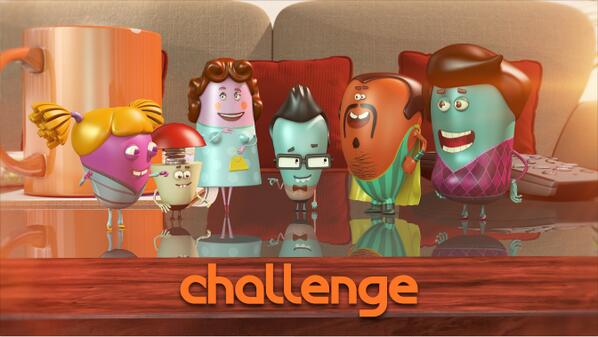
Challenge is getting a new look on Monday, apparently. Surely it’s only been like six weeks since the last rebrand?

But more importantly, next week is Going Dutch week on Bother’s Bar I have decided where we’ll take a look at some Dutch quizzes you can watch online, some of which have been going for 20+ years. I hope it will be mildly diverting.

Meanwhile Comedy Central have ordered a comedy gameshow pilot from Initial called The Almost Impossible Gameshow. It is inspired by Wipeout and viral Japanese television clips. Contestants will get five chances to complete five challenges to win a prize.

Edit: It’s all a bit Nick Weir era Catchphrase:

challenge