BIG! MONEY! BIG! PRIZES! I LOVE IT!

By | April 5, 2012

Well it’s been a bit of a dry week in terms of things to be excited about, and there probably won’t be any updates over the Easter holiday (although I’ll doubtless be around on Twitter). There won’t even be Bother’s Bar’s Sunday Night Poker on Sunday night, the first Sunday night off since the beginning of January. That measn you can watch Jimmy Carr play Deal Or No Deal cautiously for charity on Sunday night at 8pm with ease.

So to take us into Easter weekend, with the brief mention of The Hunger Games recently what better thing to look at then a one credit playthrough of hard as nails dystopian game show video game Smash TV? In particular this is the Super Nintendo Super Smash TV version. I’d buy that for a dollar! In fact I think we paid about £40 for it back in the day.

The Endemol Slot Machine

By | April 3, 2012

In case you missed it, Endemol are currently hawking round a format called The Code at MIP which we talk about in the Revolution thread (sorry). It struck me as a pretty unexciting mish-mash of old ideas (it’s ‘half questions’ + ‘random numbers’ + ‘simple logic puzzle’), it struck me that if Endemol have an idea, they’ll keep putting it in things decades later until they find something that might stick. It feels like this is a format that somebody pulled the lever on some sort of Endemol slot and that’s what came up.

So with that in mind, I’m going to pull the lever and I’ve come up with “Cash Bash” (“half questions” + “multiple choice quiz minefield” + “comedy obstacles”). This is how I envisage it working:

  • There is a path above a load of water consisting of 30 panels in 3×10 formation. To win a million pounds or whatever they have to get to the end of the path.
  • Half a question is asked and three possible answers are given – A, B or C, relating to the three panels in front of them. They pick an answer by stepping on a panel. If they are right, that’s good, if not a massive padded bar spins round and knocks them into the water.
  • Profit.

What are you going to get?

That’s Yer (Pi)Lot: Revolution

By | April 1, 2012

I would have liked to have attended this last night but I couldn’t. Happily, Friend of the Bar @ogbajoj did, and has sent us a report:

(Edit: Lewis has gone into a lot of detail here, I like detail, but it sounds as though many readers think this is a more complicated show than I think it is. So I’m trying something – if you want to get the gist of the main format points, follow the bold bits and come back for the details – some of the stuff I’ve put in at the beginning of paragraphs is my interpretation I’ve edited in. Let me know what you think.)

  • The show will be live on Saturday nights at 8pm. It was split into 5 parts, so I’d guess they’re aiming for 90 minutes. Though this was a pilot, it was pretty much recorded as-live, with minimal pickups.
  • The selling point to the execs is the at-home interaction aspect. Instead of MPD’s flash game, Revolution will be using a mobile app to play along for the chance to win some cash. No word on what platform(s) the app will be on, but we were told it will cost “a maximum of £1” so I imagine it’ll be out at 99p in the iOS app store and a similar price for Android.
  • The set is hexagonal, with a trapezium shaped screen above each side. The audience is seated in 3 groups, on alternating sides, while contestant podiums are on the unoccupied sides. The main centrepiece is the revolving gameplay area. Health and safety will be happy to know that nobody actually stands on the revolving part, there is just a large pyramid on one point of a triangle. Within the large triangle is a raised area, upon which sits a revolving turntable with 5 “money pyramids”. The entire thing seems quite dark and millionaire-y, though there are plenty of gold highlights throughout.
  • Carol Vorderman does a thoroughly ok job as host, though she did make a flub or two that will be more difficult to cover when the show goes out live. She bantered with contestants well enough, and she can read questions well enough, so she’s got the basics down.
  • There are three teams, one of one, one of five and one of twenty-five. The contestant setup is possibly the most unusual I’ve seen. On one side of the set is a lone contestant, on another side are a family of 5 with a nominated captain standing at the podium and the other 4 family members sat behind on a set of large stairs, and the third team is a team of 25 work colleagues, again with a nominated captain at the podium and the others sat on the stairs behind. (People have snuck pictures onto Twitter, here’s one, here’s another)
  • Before the title sequence there was a recap of the previous game. While this is necessary for shows like The Cube, where we can be starting mid-game, here each week’s game will be self-contained so there’s no real need for this and I don’t know why it’s there.
  • There are five money pyramids on a turntable of varying cash amounts. The game starts with five money pyramids being placed onto the turntable, three of which have £0 printed on their bases, and two with money amounts (at the start these are £50k and £100k). The pyramids are made of some refractive material, so colours can be projected into them from the turntable. The turntable spins and is lowered inside the central dais so the pyramids can’t be tracked, then raised again and slowed to a stop. This is accompanied by dramatic music and lighting which gets old fast.
  • The game starts with the lone player, who chooses one of the five pyramids, not knowing what amount is on the base. It is placed onto the larger pyramid on his end of the revolving triangle by one of three very quiet guys wearing all-black suits and black gloves. These guys always handle the pyramids very carefully to make sure the amounts are never seen until the right moment.
  • To keep the money in the pyramid, the player must get two questions right. If they get one wrong, another team gets the money. The contestant must then get a question correct twice to move the pyramid around the set completely, to regain control of it. Questions are Secret Fortune-esque, for example the first question given was “in the 1939 film The Wizard of Oz, which of these characters does Dorothy meet first?” with three options A: the lion, B: the scarecrow, or C: the tin man (spoiler: the answer is the scarecrow). As the question is first being asked, the set revolves clockwise so the pyramid is now in front of the family team. If the question is answered incorrectly, the family gain control of the pyramid.
  • However, if the question is answered correctly, the correct answer is removed and the question is asked a second time. In our example, the answers would now read A: the lion, or C: the tin man. While this is happening the pyramid is moved again, over to the team of 25, who will now gain control if the question is answered incorrectly. If the question is answered correctly twice, the pyramid moves back to where it started, it has “completed a revolution” so the lone player keeps control.
  • There seems to be a time limit on answering questions, but I couldn’t see any clock to indicate how much time there was, just Carol stating that time was up and she needed an answer.
  • No matter what happens, someone now has control of the money pyramid. They get to choose whether they want to keep it, or give it to one of the other teams. Each team can only have two pyramids at the end of round 1.
  • Now there is a space on the turntable, so a new pyramid is brought in, this time with a higher cash amount. The turntable spins, lowers, raises, and stops again, to dramatic music and lighting again.
  • The pyramid end of the triangle is now moved to the family’s area. The team captain chooses one of the pyramids to play for, again not knowing what’s on the base, and the team is asked another question. The family cannot directly confer, but are all given ask-the-audience style keypads which they must all vote on (including the captain). After time is up, the captain gets shown which answer was most popular among the family. They can choose to go with the family or choose a different answer if they’re inclined to do so.
  • The second part of the question is played by the captain alone, with no conferring or voting help from the rest of the team. Since in round 1 the control always moves clockwise, this time losing in part 1 will give the team of 25 control, and losing in part 2 will give the lone player control of the pyramid.
  • After the family’s question is over, another higher value pyramid is added, the randomization and dramatization process happens again, and the captain of the team of 25 chooses a pyramid to play for. Again, part 1 of the question is voted on, which the captain can veto if they wish, and part 2 is played by the captain alone. And again the control is moving clockwise, so a part 1 fail gives it to the lone player and a part 2 fail to the family.
  • The entire process happens for one more go around all three teams, so eventually all teams have 2 pyramids. The pyramid added after each question is higher valued than the last, and the total of all round 1 pyramids is one million pounds.
  • Of course, there is a possibility of a team gaining control of a third pyramid. In this situation, the captain can still choose to keep or pass the pyramid, but if they keep it they give away the HIGHEST value they currently hold.
  • At the end of round 1, the team with the lowest amount banked is out of the game. But their money doesn’t vanish into thin air, it gets added to the viewer prize pot for the evening, along with £100k to seed the pot.
  • At this point there are still 4 money pyramids left on the turntable. These are not removed for round 2, but there is an empty space that needs to be filled, and now they start bringing out the big money; the new pyramid is worth £250k.
  • The two teams now compete to take as many pyramids as they can with no limits, meaning there is no need to pass a pyramid any more as even a zero-value pyramid won’t hurt you. Round 2 has a lot of things I’m unclear on, since nobody managed to answer a single question correctly. I’ll try to give my understanding of it, as it was explained.
  • The process is very similar to round 1, and the questions are all in the same format as round 1, with the voting on each team and the possibility to veto all present. However, control doesn’t always move clockwise now, getting the question wrong in part 1 will always give the pyramid to the other team. Since there is an empty gap on one side of the studio, getting it wrong in part 2 will actually put the value of the pyramid into the viewer prize fund, displayed above the vacant podium. Getting it right both times completes the revolution as in round 1, giving the answering team the pyramid and the money.
  • Each team answers two questions in this round, and so four pyramids are brought into the game: the aforementioned £250k, a second £250k, a £500k pyramid and a £1M pyramid, bringing the total money introduced in round 2 up to 2 million pounds.
  • At the end of the round, again the team with the lowest prize pot must leave the game, and again their money is added to the viewer prize fund. The four pyramids left on the turntable are now discarded.
  • In this recording, the team of 25 reached the final round, so the captain was asked to pick four of his teammates to join him for the all or nothing final. I imagine the family would play the round exactly the same, as their team of 5, and the lone player would have to answer all the upcoming questions on their own.
  • The money pyramids on the turntable are now replaced with four zero-value pyramids and one pyramid representing the entire prize fund, simply marked £££. The randomization and drama process happens for the eleventh time, so nobody knows which pyramid is worth the cash.
  • Each player gets a question, a right answer owns the pyramid (hopefully it’s the one with the money), a wrong answer loses it. The captain is now shown a question category (for example, games) and has to choose a teammate to come and answer the question. The teammate chooses a pyramid to play for, and a question is presented similarly to every other question (for example, “Which of these letters is worth the most points in Scrabble? A: X, B: Y, or C: Z”). Now the captain and their chosen teammate can confer, they have the time it takes for the set to complete one full revolution to come up with an answer. The teammate has the final say on what answer is given, which is then revealed to be correct or incorrect. There is no stage 2 to any question in the final, if it is correct then the pyramid is simply lit green, if answered incorrectly it is lit red. The turntable is not randomized again after each question in the final. Instead, the next category comes up, the captain nominates another teammate to join them, and the process repeats as before. Once four of the five pyramids in the centre have been chosen and played for, the question for the last pyramid is answered by the captain alone.
  • Once all five questions are answered and all 5 pyramids are coloured, there is of course the reveal. Each of the green pyramids is a chance to win the cash, and each red pyramid is not. Each green pyramid is revealed after a dramatic pause. In this show, the team won after getting 3 of the 5 questions correct. If the team have won…
  • PYROTECHNICS! Fireworks set around the lighting rig go off with some loud booms and everyone cheers. Carol gives the outro, including the numbers for the viewer prizes and the show ends.
  • The play-along game, as mentioned earlier, is done via mobile app. The questions are given to you on the app at the same time as they are on the show. Getting every question in the show right nets you a share of the prize fund. Occasionally throughout the show, the number of players still in with a chance are given and a couple of names are picked out MPD style.
  • The audience seemed pretty enthusiastic, though there were one or two moments of confusion whether to cheer or not, particularly when a team passed a pyramid: if it’s a zero, do you cheer for them having passed correctly, or aww at the zero the other team has been given? We were told that we should be rooting for the team in control at any given time, though I get the feeling it never really cleared the confusion.
  • There are definitely some sticking points here, which could be polished before showtime. The rules were explained clearly enough as and when needed, but the nonexistent question timer still irks me. Carol is sometimes chatty with the contestants in this time too, when they should be given time to think things through, especially the lone contestant.
  • Question difficulty varied somewhat. The Scrabble question above seemed pretty easy, especially for a question in the final, but there was an earlier question which was something like “which of these movies sold the most copies on DVD in the UK in 2011?” which was near-impossible to actually know and instead relied on educated guesswork.
  • Overall I’d call this unusual: unusual team sizes, unusual play-along aspect, unusual pre-show recap, unusual number of breaks, unusual question format, unusual choice of host quite frankly. The big money and the play-along might keep people coming in, but the complex rules and different team sizes might be a turn-off, especially against whatever’s surrounding the Lottery draws that week.

Thanks very much for that Ogbajoj, I had to read it through twice to work it out, although I think I understand it. If my understanding is correct, if the in studio winner wins then the show will be giving away over £3m – that surely can’t be sustainable from a one-off 99p app so I would think that your entry represents an entry for that week only – also expect Google to crash. I’m sort of amazed and impressed that having such a complex set-up, the end game is as basic as that. Very interesting.

Endemol LIVE!

By | April 1, 2012

Just back from seeing Pulp in concert at the Royal Albert Hall, it was incredible. But there was a second rather more unexpected surprise in store – flyers for something called “Endemol – LIVE!”

I took one but I don’t have a scanner so I’m going to just type it up:

The Royal Albert Hall presents ENDEMOL LIVE!

Hit television makers Endemol celebrate years in the business with a one-off event – Endemol LIVE! In a broadcasting first, Endemol will be recreating its hit television shows LIVE! across four of the five major terrestrial channels all in one day all at the Royal Albert Hall on May 25th. And YOU can get a piece of the action!

The confirmed line-up includes:

  • For The Rest of Your Life – Nicky “White Lights” Campbell presents a special one-off edition of Endemol’s smash hit afternoon show which will go out LIVE! on ITV1
  • Deal or No Deal – LIVE! – Royal Television Society daytime winner Deal or No Deal returns for a special one-off edition LIVE from the Royal Albert Hall! For the first time, Noel will be asking select members of the audience to open the boxes whilst in the boxes!
  • Pointless – The hit BBC1 show will be going out LIVE! but in a special Endemol LIVE! twist, Alexander and Richard will have the backing of the Royal Philharmonic Orchestra. You won’t want to miss this!
  • Brainteaser – Craig Stevens returns for a very special CELEBRITY edition of hit Channel 5 show Brainteaser – LIVE FROM THR ROYAL ALBERT HALL! The celebs facing the brainy games include Brian Blessed, Gary Wilmot, Bonnie Langford and Christopher Biggins.

If that wasn’t enough, people lucky enough to be in the audience will be treated to the premiere performance of Deal or No Deal: The Musical. Danny’s (played by Brian Conley) chances of winning a lifechanging amount of money are rapidly deserting him, so he applies to be on Deal or No Deal. Will he find love on the wings, and will he take home an extraordinary amount of money? Noel Edmonds is played by Brian Blessed, Christopher Biggins plays The Banker and Gary Wilmot and Bonnie Langford are players on the wings. Songs include “Please Be A Blue, Box 22” and “The Power Five of Love”. Deal or No Deal The Musical looks set to be the next big West End hit!

How do you get tickets?

You cannot buy them. Instead, you are obliged to ring a premium rate number where some of you will be asked to leave your details. Free entry avaliable on the Endemol website.

“We’re really looking forward to this, the acoustics are meant to be tremendous.”

Well, there we are. Unexpected.

Fingers crossed we will have a recording report of Revolution with Carol Vorderman pilot for you later.

Only Kinect

By | April 1, 2012

I was given a press release a few days ago but it was embargoed until today  for whatever reason. Anyway, it’s quite exciting, it’s about a new video game and also features some news on the next series of Only Connect currently filming:

Are you good at connections? How’s your lateral thinking? And are you READY TO PARTY? Because BBC4’s hit TV quiz series Only Connect is coming to YOUR XBox 360 this Fall!

ONLY KINECT (TM) for MICROSOFT XBOX 360 (TM) KINECT (TM) is a brand new family party experience that puts your knowledge of the world around you and the things that connect other things that maybe you’ll never have considered to the ultimate test! With ONLY KINECT (TM) for MICROSOFT XBOX 360 (TM) KINECT (TM) you can experience all the fun and thrills of the TV show at home! Join host and poker player Victoria Coren as she guides you through the four fun rounds of ONLY KINECT (TM) for MICROSOFT XBOX 360 (TM) KINECT (TM). All your favourite rounds are included:

  • What’s the connection!
  • Complete the sequence!
  • The Connecting Wall!
  • Missing vowels!

ONLY KINECT (TM) for MICROSOFT XBOX 360 (TM) KINECT (TM) also features an all new PARTY MODE featuring INCREDIBLE MOTION CONTROLS! (pictured)
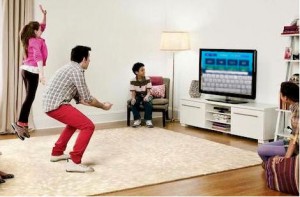
Host Victoria Coren says “I’m thrilled to be involved with ONLY KINECT (TM) for MICROSOFT XBOX 360 (TM) KINECT (TM)!”

ONLY KINECT (TM) for MICROSOFT XBOX 360 (TM) KINECT (TM) will be released on download with three full episodes for 1200 MSP (TM) with pricing for DLC to follow.

Victoria Coren FAQ:
Q:
What starting hands does Victoria normally choose to play in a game of Texas Hold ’em?
A: Only Connect-ors!

Well that does sound exciting doesn’t it? But there was a second attachment, a spokesperson from Presentable has released some information I’m going to paraphrase it in bullet point form:

    • The new series will be going out in the Autumn, but we’re currently pitching for a late Friday post-pub slot. As such the questions are likely to be a bit easier than normal – one of the questions we’ve got in the semi-final is “what connects Margret Thatcher, John Major, Tony Blair, Gordon Brown,” you know, that sort of level.
    • We’re ditching the heiroglyphs, we want something more people can associate with, so each question will now be hidden behind the faces of popular girl group Girls Aloud, with the sixth one featuring their manager Louis Walsh.
    • We’ve got some really good celebs lined up for the celebrity Children in Need specials, I don’t think I’d be getting into trouble if I revealed we’ve got Terry Christian, Toby Anstis and George Lamb coming. You know, really good celebs.
    • We’ve changed the missing vowels round. Everyone complains about the balance of it, how it feels like there are too many points avaliable in it. Well we’ve added an ingenious twist – every time the teams get a question right it adds a point to the central bank. At the end of the round both teams have to decide whether to split or steal the points. Pretty good eh? We think it will make for pretty electric television. Outgoing BBC Director General Mark Thompson has instructed all shows have some sort of brilliant Prisoner’s Dilemma aspect regardless as to whether it’s been ridiculously shoehorned in or not. “It makes all shows better. It just does.”

Blimey that all sounds rather unexpected. Looking forward to it!

If you’d like to play poker, I’m running a game this evening on Pokerstars, £5.50 to enter. Details here and all are welcome regardless of ability or league ambition, but make sure you sign up to the club (that’s free) in good time for me to admit you.

See ya!

By | March 31, 2012

So it is of course the last episode of The Weakest Link this afternoon, rather shamefully sneaking out at 3:45pm on BBC1, after Cash In The Attic. The first one was 12 years ago, and someone put it on Youtube.

Minor changes to the set and Anne Robinson’s persona aside, it’s not changed much in 12 years, maybe that’s a problem, but it was the first show probably since Neighbours in its heyday to demonstrate you could pick up really sizable audiences in daytime. My enduring memory of the first set of episodes was that there would always be a question on JD Salinger’s The Catcher In The Rye without fail. Also of note in that first episode was that the questions in the first round weren’t nearly as easy as they would be these days. The head to head still looks and feels ridiculous, it was good that they changed that a bit in the next batch of recordings.

I was a contestant in one of the early years, I had a great time and it remains a fun game to play (large groups of us on a messageboard I used to be a part of would congregate and play on Internet Relay Chat for actual money late night) although as for watching it I haven’t done so for a number of years. I can’t say I’m all that bothered by seeing it go, but it probably deserves a better send-off than it is getting.

In other news, I’ve had a press release about a certain BBC4 quiz that’s embargoed until tomorrow. It’s very exciting and will be posted automatically (because I’m out late tonight) at five minutes past midnight.